
The Overwhelming Task of Choosing the Right Health Insurance
Selecting the right health insurance policy is one of the most important financial decisions people make. But it’s also one of the most complex.
With dozens of insurers, hundreds of plans, and countless technical clauses, it’s easy to get lost in policy jargon. People often struggle with:
- Comparing benefits and exclusions across multiple policies
- Understanding hidden clauses, such as room rent caps or sub-limits
- Deciphering waiting periods for pre-existing conditions and specific treatments
- Trusting manual comparisons or insurance agents who may not always have full transparency
This lack of clarity can lead to costly mistakes, such as choosing a plan that looks good on paper but falls short when it comes to actual coverage. Many policyholders only realize the limitations of their insurance when a claim is denied or significantly reduced.
The Flaws of Traditional Insurance Selection
For decades, policy selection relied heavily on insurance agents, comparison tables, and manual research. While these methods served their purpose, they had serious drawbacks:
- Agents May Have Limited Incentive to Share Critical Details
- Some agents prioritize selling specific policies that offer higher commissions instead of the best fit for the client.
- Hidden clauses, exclusions, and sub-limits often go unnoticed until a claim is filed.
- Manual Research Can Be Time-Consuming and Inaccurate
- Most people rely on online comparisons or insurer brochures—which rarely reveal the full picture.
- Policy documents are dense with legal language, making it difficult to identify loopholes.
- Exclusions and restrictions may be buried deep in fine print, leaving policyholders unaware of crucial limitations.
- Suboptimal Policy Choices Lead to Unexpected Expenses
- Choosing the wrong policy can result in out-of-pocket costs during hospitalization.
- Claim settlement issues arise due to room rent caps, proportionate deductions, and waiting periods.
- A policy that seemed cost-effective may not provide real financial security when it matters most.
Case Example: The Cost of Ignoring Fine Print
Consider this real-life scenario:
- A 42-year-old man in Bangalore bought a health insurance plan with a ₹10 lakh sum insured.
- He assumed all hospitalization costs would be covered within this limit.
- However, his policy had a room rent cap of ₹4,000 per day.
- He was admitted to a private hospital with a ₹6,000/day room rent.
- As a result, all associated medical costs—doctor fees, ICU charges, surgery expenses—were reduced proportionately.
Despite having a ₹10 lakh coverage, he paid ₹55,000 from his pocket due to proportional deductions.
AI-Powered Policy Selection for Smarter Decisions
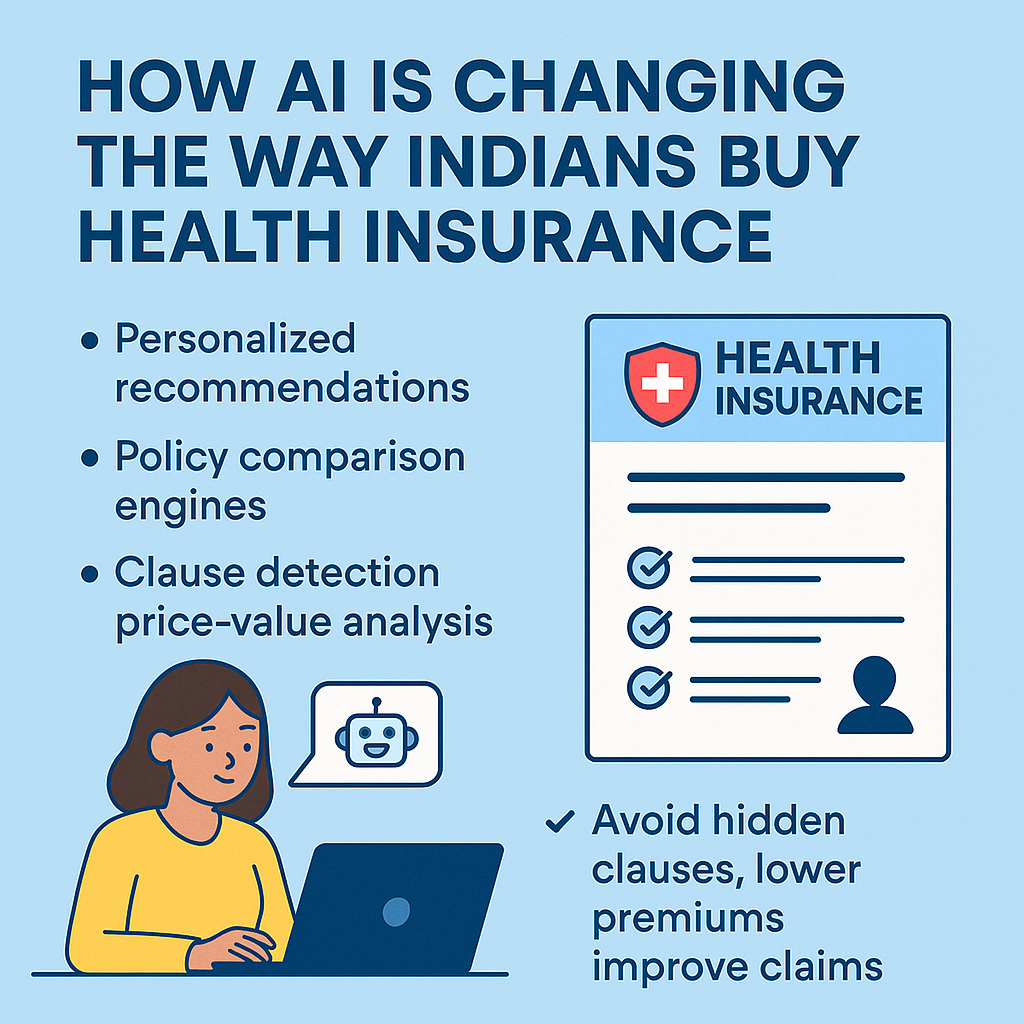
This is where Artificial Intelligence (AI) is making a significant difference. AI-powered tools analyze policies in depth, identify hidden clauses, and compare multiple options effectively, ensuring transparency and accuracy.
How AI Improves Health Insurance Selection
- Personalized Analysis Based on Individual Needs
- AI algorithms assess age, pre-existing conditions, family medical history, budget constraints, and policy preferences.
- Based on this input, AI suggests the best-suited plans rather than a generic list.
- Automated Policy Comparison Without Human Bias
- AI tools scan thousands of policy terms and conditions within seconds.
- They highlight room rent caps, sub-limits, exclusions, and provide a clear breakdown of coverage.
- The process eliminates subjective biases often found in agent-based recommendations.
- Identifying Hidden Clauses & Exclusions Upfront
- AI tools flag policies with restrictive clauses, helping users make informed choices.
- For example, an AI-driven analysis can reveal that a certain plan only covers ICU charges up to ₹50,000, even if the sum insured is ₹5 lakh.
- Real-Time Claim Settlement Data & Ratings
- AI can analyze historical claim settlement data from insurers.
- Users can check the claim rejection rates and ease of processing before buying.
- Helps in selecting insurers with a strong track record of timely settlements.
- Instant Alerts for Policy Renewal & Changes
- AI tracks upcoming policy renewals and provides alerts about premium changes.
- Some insurers revise benefits over time—AI ensures you’re informed if a plan loses its advantages.
Example: AI in Action
Imagine two policies:
- Policy A: ₹10 lakh coverage with a **5% co-payment, ₹3,000/day room rent cap, and a 2-year waiting period for pre-existing conditions.
- Policy B: ₹10 lakh coverage with zero co-payment, no room rent cap, and a reduced waiting period for pre-existing conditions.
At first glance, both policies look similar—but AI highlights critical differences.
- Policy A seems cheaper, but limits coverage significantly when a claim is filed.
- Policy B offers unrestricted hospitalization benefits, ensuring full financial protection.
By making these comparisons instant and transparent, AI helps users pick the plan that truly fits their needs.
Final Thoughts: Why AI-Based Insurance Comparison is the Future
AI is eliminating guesswork, confusion, and hidden surprises in health insurance selection. It allows policyholders to:
- Make fact-based, informed decisions rather than relying on traditional methods.
- Choose policies without hidden room rent limits, excessive co-payments, or restrictive exclusions.
- Enjoy greater financial security by avoiding unexpected out-of-pocket expenses.
Health insurance is meant to protect your finances, and AI ensures you get the right coverage without nasty surprises.